The Intersection of Probability Theory and French Roulette Variants in Regulated Digital Casinos
Written by Amir Werner · Aug 21, 2026

The Intersection of Probability Theory and French Roulette Variants in Regulated Digital Casinos
Regulated digital casinos host several French roulette variants that rely on a single-zero wheel and specific rules such as La Partage or En Prison, both of which directly alter payout structures and long-term expected values for players. These rules reduce the house edge to 1.35 percent on even-money bets compared with the 2.7 percent found on American double-zero wheels, a difference that emerges from straightforward combinatorial calculations applied to the 37 possible outcomes on a European-style wheel.
Core Probability Mechanics in French Roulette
Each spin distributes outcomes uniformly across 37 pockets when a certified random number generator operates under regulatory oversight, and the probability of landing on zero stands at exactly 1/37 while the chance of any specific number remains 1/37. Even-money wagers such as red or black therefore carry a 18/37 probability of success on a standard European wheel, yet La Partage returns half the stake when zero appears, which mathematically lowers the effective house advantage by shifting a portion of the zero outcome back to the player. En Prison achieves a similar adjustment by holding the bet for an additional spin rather than forfeiting it outright, and both mechanisms produce identical long-run expectations when applied consistently across thousands of trials.
Digital Implementation and Regulatory Standards
Regulated platforms must employ random number generators tested and certified by independent laboratories before deployment, which ensures that the theoretical probabilities remain unchanged from physical wheels. In August 2026 several European jurisdictions plan to introduce updated technical standards requiring real-time monitoring of RNG output distributions, a measure designed to detect any deviation from uniform probability across extended sequences. Observers note that these requirements align with existing frameworks maintained by the Malta Gaming Authority and the Alcohol and Gaming Commission of Ontario, both of which publish periodic compliance reports detailing audit results for roulette products.
Variants available in licensed digital environments sometimes incorporate additional side bets or modified payout tables, yet each change undergoes probability analysis before approval. A player who places a voisins du zéro bet covers a specific arc of 17 numbers and receives a payout of 8 to 1 on that wager, producing an expected value that regulators verify against the base wheel probabilities before the game reaches the market.
Statistical Behavior Across Large Sample Sizes
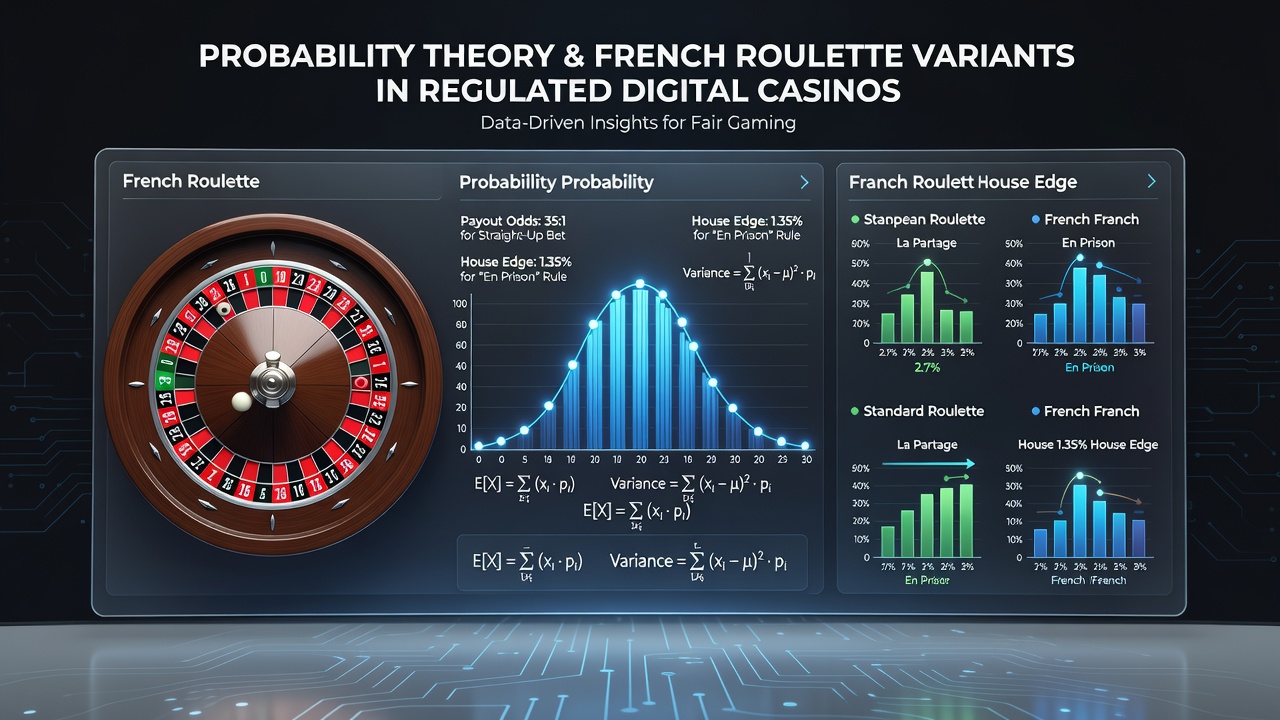
Data collected from certified platforms indicate that short-term results fluctuate around the theoretical mean, while aggregate figures over millions of spins converge toward the calculated house edge. Researchers have examined millions of recorded spins from regulated operators and confirmed that the observed frequency of zero aligns with the expected 2.7027 percent rate, with minor deviations attributable to normal statistical variance rather than mechanical bias. Those who track session-level data often find that the La Partage rule produces measurable differences in bankroll volatility compared with standard European rules, because the partial return on zero reduces the size of individual losses without altering the fundamental 37-pocket distribution.
Comparative Analysis of Variants in Licensed Markets
Digital casinos licensed in multiple jurisdictions sometimes offer both classic French roulette and accelerated versions that shorten the time between spins, yet the underlying probability model stays identical. Accelerated formats maintain the same 37 outcomes per round and apply the same La Partage or En Prison adjustments, so the long-term expectation per unit wagered does not shift. Industry reports from the European Gaming and Betting Association document that operators must submit mathematical models for each variant, including detailed payout tables and house-edge calculations, before receiving approval to launch the product.
Players who compare different regulated sites discover that the core mathematical properties remain consistent across jurisdictions even when visual themes or betting interfaces vary. A zero-landing event still triggers the same rule set regardless of whether the interface displays a virtual wheel or a live dealer feed, because regulatory certification focuses on the random outcome generation and payout logic rather than presentation.
Conclusion
Probability theory supplies the quantitative foundation for understanding how French roulette variants function inside regulated digital casinos, where single-zero wheels combined with La Partage or En Prison rules produce a documented house edge of 1.35 percent on even-money bets. Regulatory frameworks in multiple regions enforce RNG certification and periodic audits that preserve these theoretical probabilities in practice, and upcoming technical standards scheduled for August 2026 aim to strengthen real-time verification processes. The intersection of these elements demonstrates how combinatorial mathematics, independent testing, and jurisdictional oversight together maintain consistent outcome distributions across licensed platforms.